Learn

GO DEEPER

If you are like most athletes, your muscular tightness is beyond what a conventional foam roller can cure. Harder rollers and PVC pipe are not the answer either — inflexible surfaces do not work well around bone, and cannot get close to muscle attachments.

This is the short version of what we know about using these tools well: which one to pick, how to use it, and what to do about the particular place that hurts.

Selection

WHICH TOOL FOR WHICH WORK

Firmer does not mean deeper. How hard the surface feels and how far the texture reaches are two different things — and the Gator proves it, being the firmest surface here and the shallowest reach.

Firmness

How hard the surface feels under body weight. Foam density and how thick the layer is over the core.

Depth

How far the texture reaches into tissue. Bump profile height and the space between bumps.

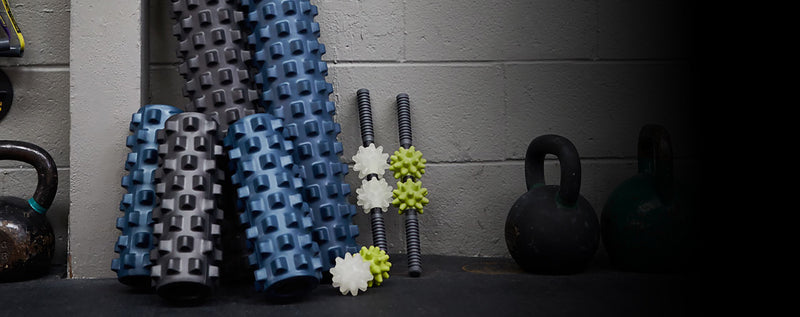
Tool Firmness Depth Built for Link
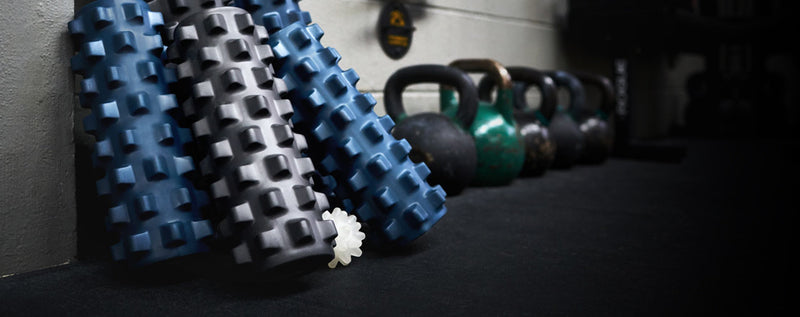
Shallow tissueGator Thin tissue close to bone and tendon — hips, the bottom of the feet, triceps, lower calf. A thinner foam layer over the core makes the surface firm, and the smaller diameter lets it work into hollows a full-size roller bridges over.
Deep tissueOriginal Bulky muscle — quads, hamstrings, glutes, lats, upper back. The right answer for most people, including professional athletes. Start here.
Deep tissue · advancedXtra Firm The same targets as the Original, for people who have stopped feeling it. Denser material, same geometry. Not a starting point.
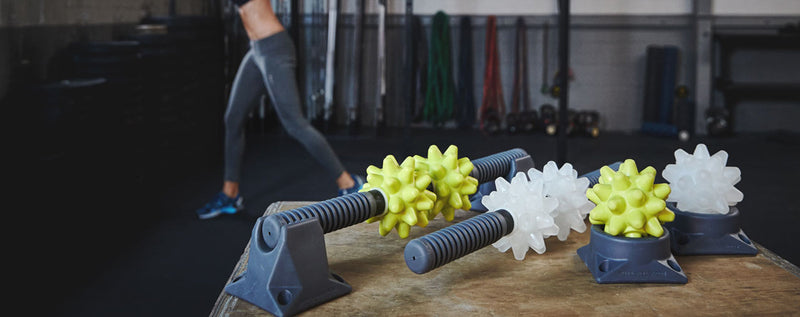
PinpointBeastie One point at a time, where a cylinder rolls straight over — the attachment at the edge of a hip, the arch of the foot, either side of the spine. Two firmnesses.

The jeopardy of going too firm is that it may be too painful — not too painful to use, but too painful to use correctly. If you are bracing against the tool rather than relaxing into it, you are not getting the work done.

WHEN A BALL BEATS A ROLLER

A knot that will not budge

When a dense knot is unresponsive to rolling, the roller is spreading its force over too much area to shift it. A Beastie puts everything you have onto one point instead.

No room, or no floor

A Beastie fits in a bag, a glove compartment or a desk drawer. A 31-inch roller does not. If you travel or train away from home, this is the tool that actually comes with you.

Getting on the floor is the problem

If lowering yourself to the floor and back up is difficult, or you are somewhere that floor work is not appropriate, a Beastie works against a wall or in a chair and gets to the same tissue.

HOW TO ACTUALLY USE IT

Slower than feels natural

An inch or two per second. Rolling fast feels productive and skips straight over the spots that need the work. When you find one, stop on it rather than rolling back and forth across it.

Your body weight is the dial

You control pressure by how much of yourself you put on the tool. Take weight onto your hands, or onto the opposite foot, to ease off. Stack the other leg on top to go harder.

A few minutes per area

Long enough for tissue to respond, short enough not to irritate it. Little and often beats one long session a week — most people get more from ten minutes most days.

Breathe, do not brace

The most useful gauge you have. If you are holding your breath or clenching everything around the area, the pressure is too high — ease off until you can breathe normally through it.

By body area

WHERE IT HURTS

Upper back and lats

Original, full or mid size. Lie back over the roller with it across your upper back, hands behind your head, and lift your hips just off the floor. Move in short ranges rather than rolling the whole spine, and stay on the muscle either side of the spine rather than the bones themselves.

For the lats, roll onto your side with your arm overhead and the roller in your armpit, then work down the side of your ribcage.

Lower back and glutes

Beastie, or the Original for glutes. Do not roll directly on the lower spine. Most of what people call lower back tightness responds better to work on the glutes and the muscles running alongside the spine.

Sit on the roller or a Beastie with one ankle crossed over the opposite knee, and lean into the glute of the crossed leg. A Beastie against a wall is the easier version if the floor is too much.

IT band and quads

Original for quads, Gator for the IT band. Quads take a full-size roller well — face down, roller under the thighs, working from above the knee to the hip.

The IT band is thin tissue over bone, which is exactly where the Gator's firmer surface and shallower reach make more sense than a deep-tissue roller. Expect it to be uncomfortable; ease off by taking weight onto your hands.

Hamstrings

Original. Sit with the roller under one thigh and the other leg crossed over it for extra pressure, hands behind you. Work from just above the knee to just below the glute.

Hamstrings tend to be less sensitive than quads, so this is often where people first notice the bumps doing something a smooth roller does not.

Calves and the bottom of the feet

Gator or Beastie. Both areas are thin tissue close to bone, and both sit in hollows that a full-size roller bridges straight over.

For the arch of the foot, stand and roll a Beastie underfoot with as much weight as you can tolerate — hold a wall or chair. For calves, sit with the tool under one calf and the other leg stacked on top.

Neck and shoulders

Beastie against a wall. This is the area where a floor and a full-size roller are hardest to control, and where too much pressure is easiest to apply by accident.

Put a Beastie between your shoulder blade and a wall, lean in, and move slowly. Work the muscle of the shoulder and upper trapezius, and stay off the front and sides of the neck entirely.

Still not sure?

Tell us the area you are working on and we will tell you which tool fits.

Discomfort is not the same as pain

WHAT IS NORMAL, AND WHAT IS NOT

Some discomfort is normal, especially on tight areas and in the first few sessions. It should ease as you work, and you should be able to breathe through it.

Sharp pain is not normal. Neither is numbness, tingling, or pain that radiates away from the spot you are working on. If you get any of those, come off the tool.

If you have persistent or severe pain, a recent injury, or you are recovering from surgery — or if you are pregnant, or being treated for a circulatory or nerve condition — talk to a licensed healthcare provider before using any self-massage tool. We sell recovery equipment; we are not qualified to diagnose what is wrong with you.

Keep going

WHERE TO NEXT