CROSS-FRICTIONAL MASSAGE

RumbleRoller Gator

RumbleRoller Gator

Not a softer RumbleRoller, and not a firmer one. The Gator works by a different mechanism — and that is the whole point of it.

Regular price $54.95 USD
Regular price $54.95 USD Sale price $54.95 USD
Sale Sold out
Shipping calculated at checkout.

Grips skin well enough to shear the upper layers of tissue against the ones underneath — the motion a therapist makes across muscle fibres, not along them.

About 4.5" across. A narrower cylinder concentrates your weight over less contact area, so the surface feels firm without a flat, unforgiving edge.

Drops into places a wider roller bridges over — the arch of the foot, the curve of the neck, the space around the hip.

In stock

Lifetime Satisfaction Warranty — return it at any time, for any reason.

Free standard US shipping, no minimum — $18 to Alaska, Hawaii and Puerto Rico. Ships to 40+ countries.

Independently lab-tested to CPSIA for lead and phthalates. Latex-free.

COMPLETE THE SYSTEM

The Gator works shallow tissue. These reach the single points it rolls straight over.

Beastie Massage Ball

Regular price From $27.50 USD
Regular price Sale price From $27.50 USD

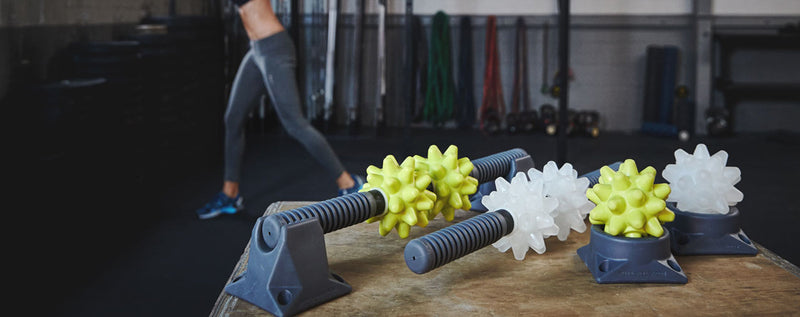
Pinpoint pressure for the knots a roller passes straight over. Ships with a base that holds it still.

Beastie Adjustable Peanut

Regular price $37.50 USD
Regular price Sale price $37.50 USD

Straddles the spine so you can work either side of it, not on it. Width adjusts.

Beastie Bar

Regular price From $42.50 USD
Regular price Sale price From $42.50 USD

Two-handed control for calves, forearms and quads without getting on the floor.

Beastie Ball Base

Regular price $9.95 USD
Regular price $9.95 USD Sale price $9.95 USD

A spare base. Holds the ball still so you can work a spot instead of chasing it.

RumbleRoller Gator

Selection

FIRMER DOES NOT MEAN DEEPER

The Gator is the proof. Its surface feels firmer than the Original while reaching less deeply into tissue — because how hard a surface feels and how far its texture reaches are two different things.

Firmness

How hard the surface feels under body weight. Foam density and how thick the layer is over the core.

Depth

How far the texture reaches into tissue. Bump profile height and the space between bumps.

Tool Firmness Depth Built for Link
Shallow tissueGator — you are here Thin tissue close to bone and tendon — hips, the bottoms of the feet, triceps, lower calf. A thinner foam layer over the core makes the surface firm; the lower-profile texture keeps it from digging.
Deep tissueOriginal Bulky muscle — quads, hamstrings, glutes, lats, upper back. The right answer for most people, including professional athletes.
Deep tissue · advancedXtra Firm The same targets as the Original, for people who have stopped feeling it. Denser material, same geometry. Not a starting point.
PinpointBeastie Single-point work no roller can reach. Two firmnesses — Original, and an Xtra Firm about as hard as a lacrosse ball.

Choose by where the work is, not by where you sit on a toughness scale. Thin tissue over bone wants the Gator; bulky muscle wants the Original.

What you will actually do with it

Three positions to start with. The Gator's signature use — the IT band, along with the bottoms of the feet and the triceps — is in the Gator guide, along with the cross-friction technique.

Rolling the calves on a Gator

Calves and lower leg

45 sec each side

Sit with the back of one calf on the roller, hands on the floor behind you, ankles relaxed. The calf sits in a hollow that a 5- or 6-inch roller bridges straight over; a 4.5-inch cylinder drops into it. Cross your legs at the ankle to go harder.

Rolling the glutes on a Gator

Hips and glutes

45 sec each side

Sit on the roller with one foot crossed to the opposite knee, hands behind you. Slowly rock and roll the glute of the bent leg, working out toward the point of the hip where tissue thins and bone is close.

Rolling the mid and upper back on a Gator

Mid and upper back

60 sec

Face-up, knees bent, feet flat, head and neck neutral. Roll from the lower trapezius to the top of the rhomboids, rocking left and right. The narrower cylinder settles into the groove either side of the spine rather than bridging it. Stay between those two points — do not roll on up onto your neck.

Read the full 10-minute routine Six positions, about ten minutes, free and no sign-up.

A different kind of pressure

The Gator is not a softer RumbleRoller or a firmer one. It works by a different mechanism, and that is the whole point of it.

Cross friction, not just compression

Pressing harder is only one way to work a muscle. Another is to pull tissue apart — moving the upper layers to create a shearing force against the layers underneath. Massage therapists do this by hand, with short firm strokes across the muscle fibres rather than along them. The Gator's surface grips skin well enough to reproduce that motion, which no smooth roller and no bumped roller can do.

Small diameter, high compression

At roughly 4.5" across, the Gator is noticeably narrower than the Original. A narrower cylinder concentrates your body weight over less contact area, so the surface feels firm — comparable to rolling on PVC pipe, without the unforgiving flat surface.

That narrow profile also lets it drop into places a wider roller bridges straight over: the arch of the foot, the curve of the neck, the space around the hip.

Where it belongs

Use the Gator where tissue is thin and bone is close — hips, the bottoms of the feet, triceps, the lower calf near the tendon. Its thinner foam layer and lower-profile texture mean it does not dig the way the Original does, which is exactly what you want in those places and not what you want on a quad.

It is more approachable than our deep-tissue rollers. It is not a beginner's roller.

One size. Approximately 4.5" in diameter — noticeably narrower than the 5" to 6" of the Original range, which is what produces its higher compression and lets it reach into smaller contours.

Solid core of high-density EVA foam with a moulded outer layer. The surface texture is lower-profile than the Original's bumps and is designed to grip rather than dig.

The texture permanently retains its shape and resiliency — it does not flatten out with use.

Wipe clean with a damp cloth and mild soap. All RumbleRoller products are latex-free and have been independently lab-tested in accordance with the Consumer Product Safety Improvement Act for lead and phthalates.

Free standard shipping on every US order, with no minimum. Alaska, Hawaii and Puerto Rico are a flat $18, and Canada is a flat $30. We ship to more than 40 countries.

Covered by the Lifetime Satisfaction Warranty: return at any time, for any reason, for replacement, exchange, or a refund up to full MSRP. You cover return shipping, and it applies once per product type. There is no window to miss.

CROSS FRICTION

SHALLOW TISSUE

LIFETIME WARRANTY

SINCE 2009

CROSS FRICTION

SHALLOW TISSUE

LIFETIME WARRANTY

SINCE 2009

CROSS FRICTION

SHALLOW TISSUE

LIFETIME WARRANTY

SINCE 2009

CROSS FRICTION

SHALLOW TISSUE

LIFETIME WARRANTY

SINCE 2009

CROSS FRICTION

SHALLOW TISSUE

LIFETIME WARRANTY

SINCE 2009

CROSS FRICTION

SHALLOW TISSUE

LIFETIME WARRANTY

SINCE 2009

CROSS FRICTION

SHALLOW TISSUE

LIFETIME WARRANTY

SINCE 2009

CROSS FRICTION

SHALLOW TISSUE

LIFETIME WARRANTY

SINCE 2009

CROSS FRICTION

SHALLOW TISSUE

LIFETIME WARRANTY

SINCE 2009

CROSS FRICTION

SHALLOW TISSUE

LIFETIME WARRANTY

SINCE 2009

TWO WAYS TO FREE STUCK TISSUE

Pressing is one way

Every roller compresses. You put weight on tissue and squeeze it against what is underneath. It works, and it is most of what foam rolling is.

Pulling is the other

You cannot grab deep tissue directly. But you can move the layers above it and create a shearing force that displaces the layers below — which frees tissue that compression alone leaves stuck.

Therapists do it by hand

Short, firm strokes drawn across the muscle fibres rather than along them. It is a standard manual technique, and it is not something a smooth cylinder can imitate.

The Gator grips

Its surface holds skin well enough to carry it with the roll instead of sliding over it. That grip is what turns a rolling motion into a shearing one.

Where it belongs

THIN TISSUE, CLOSE TO BONE

Hips. The bottoms of the feet. Triceps. The lower calf where it runs into the tendon. These are the places a deep-tissue roller is the wrong tool — there is not enough tissue between the surface and the bone for high-profile bumps to work into.

The Gator's thinner foam layer and lower-profile texture mean it does not dig the way the Original does. In these places that is exactly what you want. On a quad it is not.

Owners

WHAT PEOPLE WHO OWN ONE SAY

No reviews on this page yet. If you own one, yours would be the first.

Before you buy

STRAIGHT ANSWERS

Gator or Original?

Different jobs, not different difficulty levels. The Original is built for bulky muscle — quads, hamstrings, glutes, lats, upper back — where high-profile bumps have tissue to work into. The Gator is built for places where tissue is thin and bone is close: hips, the bottoms of the feet, triceps, lower calf. Most people who own both use them on different parts of the same session.

Is the Gator a beginner's roller?

It is more approachable than our deep-tissue rollers, because the lower-profile texture does not dig in the same way. But that is a side effect of what it was designed for, not the point of it. Experienced users reach for a Gator because of what it does in specific places — not because it is easier.

What is cross-frictional massage?

Pressing harder is one way to work a muscle. Another is to pull tissue apart — moving the upper layers so they shear against the layers underneath. Massage therapists do this by hand with short, firm strokes drawn across the muscle fibres rather than along them. The Gator's surface grips skin well enough to reproduce that motion as you roll.

Why does it feel firmer if it reaches less deeply?

Because those are two different properties. At roughly 4.5 inches across, the Gator is narrower than the Original range, so your body weight is concentrated over a smaller contact area — which is what makes the surface feel firm. Meanwhile its texture is lower-profile and its foam layer thinner, so the shape reaches less far into tissue. Firmer surface, shallower reach.

Is it supposed to be uncomfortable?

Some discomfort is normal, especially on tight areas and in the first few sessions. Sharp pain is not. Ease off or use less body weight. If you have persistent or severe pain, numbness, radiating pain, a recent injury, or you are recovering from surgery, talk to a licensed healthcare provider before using any self-massage tool.

Still deciding?

Tell us the area you are working on and we will tell you which tool fits.

RECENTLY VIEWED