Since 2009

WE MADE THE ROLLER WE COULD NOT BUY

RumbleRoller started as a long friendship between a manufacturer and an athlete who kept getting hurt. Mike Jastram had spent years building industrial parts and assemblies. Ron Johnson was an engineer who had already developed several fitness and rehabilitation products — and who had spent more than two decades looking for something that would actually reach the damage in his own body.

The problem

A SMOOTH CYLINDER WAS NO MATCH

Ron met his first foam roller in the mid-1990s. He liked that it let him work on himself without booking an appointment. He did not like the results — a smooth cylinder was no match for the deep restrictions and scarring left by too many training injuries.

The idea sat there for a decade. By 2005 he had stopped treating it as a frustration and started treating it as a design problem: how do you reach deeper tissue without simply making the tool harder?

2005 to 2009

NEW POLYMERS, NEW GEOMETRY

The early prototypes failed in two directions. Some were too difficult to manufacture. Others did not survive heavy use — and the whole point was a tool that would still be working years later.

In early 2009 Mike and Ron found the combination that held: new polymers and molding technologies that could produce firm but flexible bumps over a resilient high-density core. They registered rumbleroller.com in May. The first RumbleRollers sold that October.

WHAT THE BUMPS ACTUALLY DO

They reach further

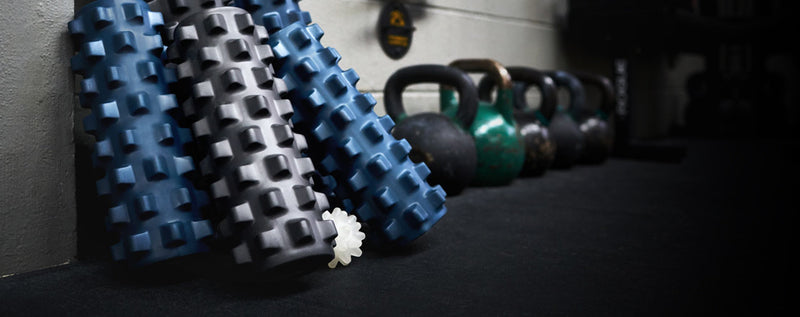
High-profile bumps penetrate deeper than a flat surface can. A smooth cylinder presses tissue flat against itself; a bump pushes into it.

Tissue has somewhere to go

The large spaces between the bumps give displaced soft tissue room to move, instead of compressing it against itself.

Firm, but not rigid

Harder rollers and PVC pipe are not the answer. Inflexible surfaces do not work well around bone, and cannot get close to muscle attachments. Ours flex where they need to.

Protected, and copied

The bump geometry is covered by three US patents — D660,450, 9,039,641 and 9,320,675. Everything that came after has been a variation on it, including the imitations.

How it is made, and how it is backed

BUILT TO OUTLAST THE INJURY

Rollers are manufactured in Taiwan; Beastie products are made in the USA. Every product is independently lab-tested in accordance with the Consumer Product Safety Improvement Act for lead and phthalates, and everything we make is latex-free.

All of it is covered by the Lifetime Satisfaction Warranty — return a RumbleRoller at any time, for any reason, for a replacement, an exchange, or a refund up to full MSRP. There is no window to miss. We are confident enough in how these hold up to offer it, and it has been in place since the beginning.

RumbleRoller products are now distributed in more than 40 countries and used by millions of athletes.

Where to start

NOT SURE WHICH ONE?

For most people, including professional athletes, the Original is the right answer — firmer does not mean deeper, and going too firm too early usually means using it badly rather than using it well.

Shop foam rollers · Shop Beastie · Read the FAQ · Ask us directly